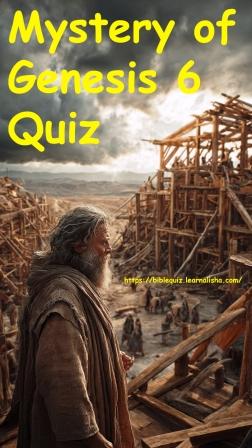
Are You Ready to Unlearn What You Know? Mystery of Genesis 6 Quiz Think you know the story of Noah? Most of us remember the wooden boat and the pairs of animals. But if you skip straight to the rain, you miss the most disturbing, mysterious, and high-stakes chapter in the Torah. Genesis 6 isn’t just about a boat; it’s about a cosmic crisis where the boundaries between heaven and earth blurred. Whether you are prepping for your next Bible study or you’re a seeker looking for the “why” behind the Flood, we’re about to dive into the blueprint of a world gone wrong.
You’ve waded through the murky waters of the Nephilim and explored the grieving heart of the Creator. But did you catch the subtle details that separate a casual reader from a true student of the Word?
It’s time to see if your foundation is as solid as the Gopher wood of the Ark. Step into our Genesis 6 Knowledge Check to see how much of this ancient blueprint you’ve truly mastered.
Genesis Chapter 6 Mastery Challenge
Explore the story of Noah, the corruption of the earth, and the instructions for the Ark.
Challenge Complete!
Score: /10
Awarded to
Genesis Chapter 6 Mastery
Score: /10
Verified at: https://biblequiz.learnalisha.com/
Genesis 6 Answer Key
Who were the Nephilim and why were they on earth?
The Nephilim were the offspring of the “sons of God” and the “daughters of humans,” described as ancient heroes and men of renown. Their presence represents a violation of the divine order, contributing to the widespread violence and corruption that ultimately led God to purify the earth.
In more human terms, this wasn’t just a physical invasion; it was a spiritual catastrophe. Many scholars argue that the “sons of God” were fallen angelic beings. Their attempt to mingle with humanity was a “Pattern Interrupt” to God’s design. It wasn’t just that people were “being bad”—it was that the very fabric of human nature was being compromised by an external, rebellious force.
Why did God decide to destroy the world with a flood? Mystery of Genesis 6 Quiz
God sent the Flood because the earth had become filled with “hamas” (violence) and every human thought was continually evil. The destruction was a judicial act of de-creation, intended to wash away the systemic corruption and provide a “reset” for a righteous remnant through Noah.
It sounds harsh to our modern ears, doesn’t it? But imagine a world where there is no law, no safety, and total darkness in the human heart. When God looked at the earth, He didn’t see a few mistakes; He saw a masterpiece that had been defaced beyond recognition. The Flood wasn’t just a punishment; it was a desperate, grieving act of a Creator who refused to let His creation suffer in perpetual chaos.
How did Noah find favor in the eyes of the Lord?
Noah found favor not because he was sinless, but because he was “blameless in his generations” and walked faithfully with God. His obedience in building the Ark, despite no visible sign of rain, demonstrated a level of trust that set him apart from his violent peers.
Notice that the text says Noah “walked with God.” This is a callback to Enoch and a foreshadowing of the intimacy God desires with all of us. While everyone else was looking at the ground (or at themselves), Noah was looking up. He survived the storm because he was anchored to the Creator before the first drop of water ever fell.
Contextual Analysis: The Weight of “Good” vs. “Grief”
In the first chapter of Genesis, we see a beautiful rhythm. God speaks, and it is good. On the sixth day, after creating humanity, He declares it “very good” (tov me′od).
By Genesis 6, the vocabulary shifts dramatically. The Hebrew word for “grieved” (atsab) used here suggests a deep, piercing pain in the heart. The “Blueprint” shows us that God is not a distant, cold judge. He is an invested Father. The transition from the “Very Good” of creation to the “Grief” of Genesis 6 shows that human choice has real, cosmic consequences. God’s “No” to the world’s violence was a “Yes” to humanity’s future.
Common Misconceptions about Mystery of Genesis 6 Quiz
- The “Sethite” View is the only one: Many people assume the “sons of God” were just the descendants of Seth (the “good guys”). However, the ancient context and the original Hebrew often point to a much more supernatural event involving celestial beings.
- The Nephilim were just “big guys”: While often translated as “giants,” the root word naphal means “the fallen ones.” Their height was secondary to their spiritual status as symbols of rebellion.
- God changed His mind: When the Bible says God “relented” or “repented,” it doesn’t mean He made a mistake. It describes a change in His relational direction based on the radical change in human behavior.
Written by: Learn Alisha
Subject Matter Expert: Biblical Theology & Ancient Near Eastern Context.
Last Updated: April 16, 2026
Review Status: Fact-checked for Theological Accuracy.